


 Verified Purchase


The Hive Mind · Issue 018 · 5 min read
In 2014, a PhD student in Israel collecting samples around the clock found that the trillions of bacteria in your gut rise, fall, and migrate on a 24-hour rhythm — and that rhythm decides what they build while you sleep.
In 2014, a graduate student named Christoph Thaiss was collecting samples from mice every four to six hours, around the clock, at the Weizmann Institute of Science in Rehovot, Israel.
It was tedious work. Through the day, through the night, for days at a time. He was studying the gut microbiome — the trillions of bacteria that live in the intestines of every mammal, including us. At the time, the prevailing view was that a healthy adult’s microbiome was essentially stable: a fixed community, like a forest, changing slowly over months or years with diet, illness, or age, but more or less constant from one hour to the next.
Thaiss was sampling so frequently because he wanted to be thorough. He did not expect the timing to matter.
It mattered.
The population that would not hold still
When Thaiss and his colleagues sequenced the samples, they found that the microbiome was not stable at all. It was moving.
More than fifteen percent of the bacterial species in the mouse gut rose and fell in abundance on a regular twenty-four-hour cycle. Some species were numerous at midday and scarce at midnight. Others did the reverse. The bacteria were not just changing in number — they were changing in behavior. Nearly a quarter of the metabolic pathways encoded in the bacterial genomes switched on and off depending on the time of day. And the bacteria were physically moving, shifting their position along the intestinal wall, so that the lining of the gut was exposed to a different microbial community, producing different chemicals, at different hours.
The microbiome was not a forest. It was a tide.
When the team checked human samples, the same pattern held. In people, roughly ten percent of gut bacterial species and twenty percent of their functional pathways oscillated across the day. The finding, published in the journal Cell in 2014, opened an entire field of research.
A clock with no eyes
This raised an obvious question. The body’s master clock — the one we covered in Issue 001, and again in Issue 016 — is set by light. Light enters the eye, reaches the brain, and calibrates the circadian system to the solar day.
But the bacteria in your gut have never seen light. They live in total darkness. So what was setting their clock?
The answer was food.
Thaiss’s team found that the microbiome’s daily rhythm was driven almost entirely by the timing of meals. When mice ate on a normal schedule, the bacterial tide rose and fell predictably. When the researchers disrupted the feeding schedule, the oscillations flattened out. The tide stopped moving. And the gut fell into a state the researchers called dysbiosis — a disordered microbial community linked to inflammation and metabolic disease.
The gut keeps a clock. That clock is not set by sunrise. It is set by the hour you eat.
The night shift
Here is where it connects to your sleep.
The bacterial activities that peak during the rest phase — the hours you are asleep — are not the same as the ones that peak while you are active. During the fed, active part of the day, the bacteria are largely occupied with energy metabolism: breaking down what you have eaten. During the rest phase, a different set of genetic programs comes forward — pathways involved in repair, in the turnover of the gut lining, in detoxification and environmental sensing.
Your gut, in other words, runs a night shift. And the chemistry of that night shift matters to the rest of you. In Issue 007 we covered how the gut produces the overwhelming majority of the body’s serotonin — the precursor to melatonin, the molecule of sleep. The bacteria are also a major source of short-chain fatty acids like butyrate, compounds that calm inflammation and influence the brain. These are not produced at a constant rate. They are produced rhythmically, and the rhythm depends on the gut clock being properly set.
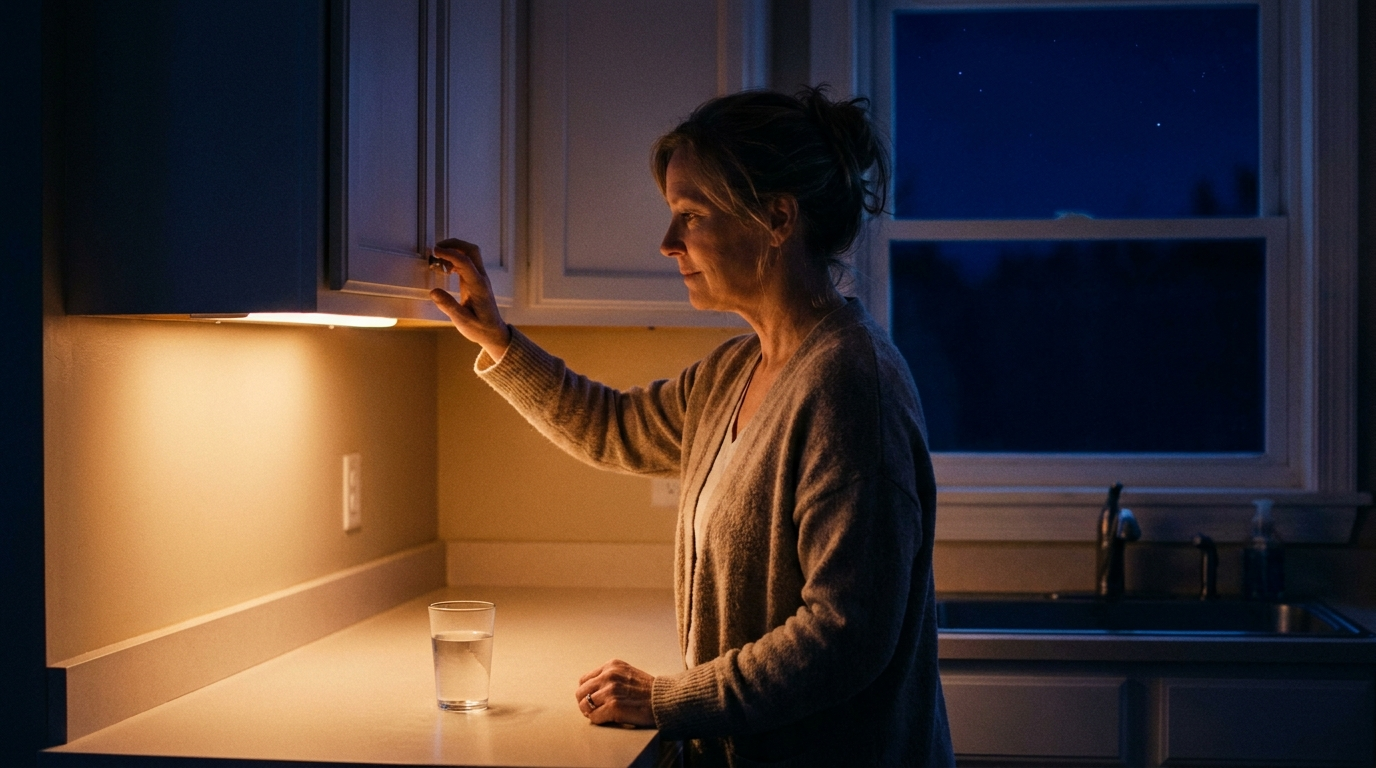
When the gut clock is aligned — when meals come at consistent times and the eating stops well before sleep — the night shift runs cleanly. The repair pathways get their window. The calming metabolites are produced on schedule. When the gut clock is scrambled — late dinners, midnight snacks, meals at unpredictable hours — the brain may still register a full night in bed, but the body underneath it did not get a clean overnight shift. And you wake up feeling it.
Why this matters more after 50
Two things change with age, and they compound.
The first is the microbiome itself. After fifty, the gut microbial community tends to lose diversity and resilience. It becomes more easily disrupted and slower to recover. A scrambled feeding schedule that a thirty-year-old’s gut would shrug off can knock an older microbiome out of rhythm for longer.
The second is gut motility — the pace at which the digestive system moves. It slows with age. Food eaten late sits longer. A dinner at nine that would have cleared quickly in a younger body is, in an older one, still being processed well into the hours meant for rest. The gut never gets its clean overnight window, because it is still doing the day’s work.
This is part of why the same late meal that did nothing to your sleep at thirty quietly costs you at sixty. The system has less margin. The timing matters more, not less.
The one thing worth trying tonight
There is one change that works directly with this system, and it costs nothing.
Stop eating about three hours before you go to bed.
Not a diet. Not a restriction on what you eat. Simply a boundary on when. Three hours is enough time for the bulk of digestion to wind down, for the gut to begin its transition from the day’s metabolic work into the overnight repair shift. You are not depriving the bacteria. You are giving them a clean handoff — the same clean handoff your brain’s clock gets from darkness.
The gut microbiome is, in a sense, the oldest part of you — bacteria were keeping time on this planet billions of years before there were eyes to see light. What Christoph Thaiss found in those around-the-clock samples is that this ancient system is still running inside you, still keeping its own time, still waiting every night for the signal that the day is done. Give it the signal. Let the kitchen go quiet a few hours early. The night shift will take it from there.
— The Hive Mind
Until next issue
Next: why a certain kind of weight on the body convinces the nervous system it is safe — and the discovery, made by someone studying something else entirely, that explains why a heavier blanket can change a night.
Built to Support Your Body’s Natural Rhythm
Beezy Beez Botanical Extract Sleep Honey is designed to support the wind-down phase of your circadian cycle — when your body wants to drop into rest, but stress or overstimulation gets in the way. Clean ingredients. Trusted by 8,500+ five-star customers.
TRY SLEEP HONEY →The Hive Mind Newsletter
Every issue, in one place.
One sleep science deep-dive every three days — from Issue 001 to the latest. Free to read, no sign-up required.
Browse the Archive →About Beezy Beez. Beezy Beez crafts botanical extract honey for people navigating sleep changes after 50. The Hive Mind is the brand’s editorial letter on the science and history of rest.