What Honeybees Know About Sleep That We Forgot
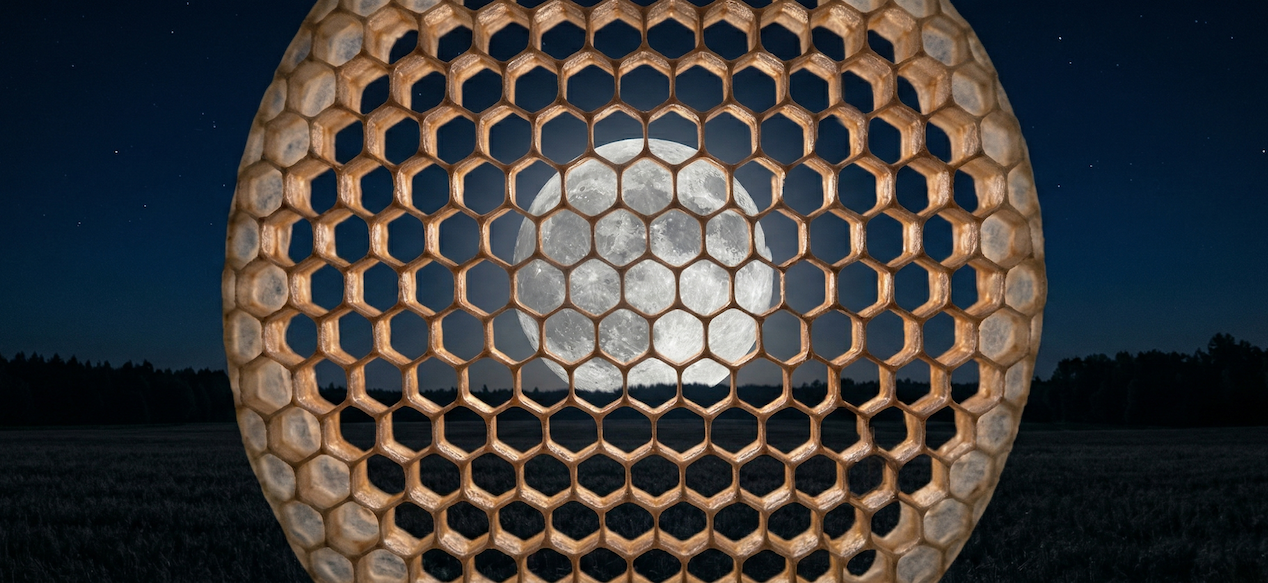
The honeybee solved the problem of restorative sleep 2.5 billion years ago. Your cells are still running on the same operating system tonight — whether you're working with it, or against it.
The Story of the Honeybee
Here is something most people don't know about honeybees: they sleep.
Not metaphorically. Not in a simplified, insect-adjacent way. They sleep in cycles that look remarkably like our own — periods of light rest, deep stillness, and something researchers now believe functions like REM sleep. The phase where humans consolidate memory and process emotion.
When a young bee is learning the geography of its hive — the location of every comb, the direction of every foraging route — it rehearses those spatial maps during sleep. Deprive it of sleep and it forgets. The map dissolves. It gets lost.
Sound familiar?
The reason this matters for your sleep tonight isn't just poetic. It's structural. The bee's sleep and your sleep are running on the same ancient operating system. Understanding how that system works — and more importantly, what disrupts it — is the difference between waking up restored and waking up wondering why eight hours felt like three.
The 2.5-Billion-Year-Old Clock Inside Every Cell
During deep sleep — what neuroscientists call slow-wave sleep — your brain runs a process called memory consolidation. Everything you encountered today: the conversation you had, the problem you turned over, the name you keep forgetting — all of it gets transferred from short-term storage in the hippocampus into long-term memory across the cortex.
This cannot happen while you're awake. There is no waking substitute.
But here's what most sleep advice misses entirely — and what the bee already knew intuitively: the timing of your sleep matters as much as the duration.
Bees don't just sleep. They sleep in synchrony with the sun. Their circadian clock is so precise that researchers have used bees as living timepieces — setting them near feeding stations and watching them arrive at exactly the right hour, day after day, across weeks, without any external cue.
Their sleep isn't random rest. It's biological architecture. And yours is too, whether you're treating it that way or not.
The circadian clock is not a metaphor. It is a literal molecular mechanism that exists in virtually every cell of your body — not just your brain, but your liver, your heart, your immune system, your gut. Every cell is running a 24-hour program.
This mechanism is estimated to be over 2.5 billion years old. Older than multicellular life. Older than animals, older than plants. The first organisms to evolve it were single-celled bacteria, almost certainly in response to the predictable rhythm of ultraviolet radiation from the sun.
The oldest living technology on Earth is a clock. And you have one inside every cell.
When that clock is aligned — when your sleep, light exposure, eating, and activity follow a consistent rhythm — everything coordinates. Cortisol peaks in the morning exactly when you need alertness. It drops by evening as you want it to. Body temperature falls at night to signal sleep. Melatonin rises in darkness at precisely the right hour.
When the clock is disrupted — irregular sleep timing, artificial light at night, stress that keeps cortisol elevated through the evening, eating at inconsistent hours — the coordination breaks down. Every cell is running a slightly different program. Your immune system doesn't know when to be active. Your gut doesn't know when to process. Your brain doesn't know when to consolidate.
This is not a sleep problem. It is a timing problem.
And that distinction changes everything about how you fix it.
In ancient Egypt, sleep was not considered a passive state. It was called irt n Ra — "the eye of Ra," the sun god — implying that sleep was the moment when you were most directly connected to the organizing intelligence of the universe.
Egyptians practiced what historians now call incubation sleep — deliberately sleeping in sacred sites and temples with the intention of receiving healing, guidance, or insight. The god Serapis presided over healing dreams. Petitioners traveled for days to sleep in his temple.
This sounds like superstition. It wasn't.
During sleep, the glymphatic system — a network of channels surrounding the brain's blood vessels — flushes metabolic waste from the brain tissue. This system is almost completely inactive while you're awake. It becomes fully operational during deep sleep.
Among the waste it clears: amyloid beta and tau proteins. The same proteins that accumulate in the brains of people with Alzheimer's disease.
Your brain cleans itself at night. If you don't sleep, it doesn't clean.
The Egyptians didn't know this mechanically. But they understood that sleep was not an interruption of life — it was the part of life where the most essential things happened. Things that couldn't happen any other way.
They treated it accordingly. We, collectively, do not.
The One Sleep Change That Matters Most This Week
Most sleep advice focuses on duration. Eight hours. Nine hours. Consistent bedtime.
Duration matters. But alignment matters more — and it's far easier to change than you think.
The single most impactful thing you can do for your sleep quality this week — more than blackout curtains, more than any supplement, more than any tracking device — is to align your sleep with a consistent rhythm.
Not necessarily earlier. Not necessarily longer. Consistent.
The same bedtime within a 30-minute window. The same wake time within a 30-minute window. Every day — and this is the part that's hard — including weekends.
Your circadian clock calibrates itself to the pattern you give it. Give it a consistent pattern and it starts doing its job precisely. Give it an irregular pattern — late Friday, later Saturday, "catching up" on Sunday — and you are, biologically, flying to a different time zone and back every single week.
The bee doesn't sleep in on Saturday. Its circadian clock doesn't know it's the weekend. Your cells are doing the same math. The question is whether you're helping them or fighting them.
Built to Support Your Body’s Natural Rhythm
Beezy Beez Botanical Extract Sleep Honey is designed to support the wind-down phase of your circadian cycle — when your body wants to drop into rest, but stress or overstimulation gets in the way. Clean ingredients. Trusted by 8,500+ five-star customers.
Try Sleep Honey →The Hive Mind Newsletter
Every issue, in one place.
One sleep science deep-dive every three days — from Issue 001 to the latest. Free to read, no sign-up required.
Browse the Archive →