


 Verified Purchase


The Hive Mind · Issue 006 · 7 min read
A Swiss physiologist found it in 1932 by accident — a circuit so precise that two stimulations millimeters apart produced opposite states of the entire nervous system. He won the Nobel Prize for it. Most adults reading this have one stuck in the wrong position.
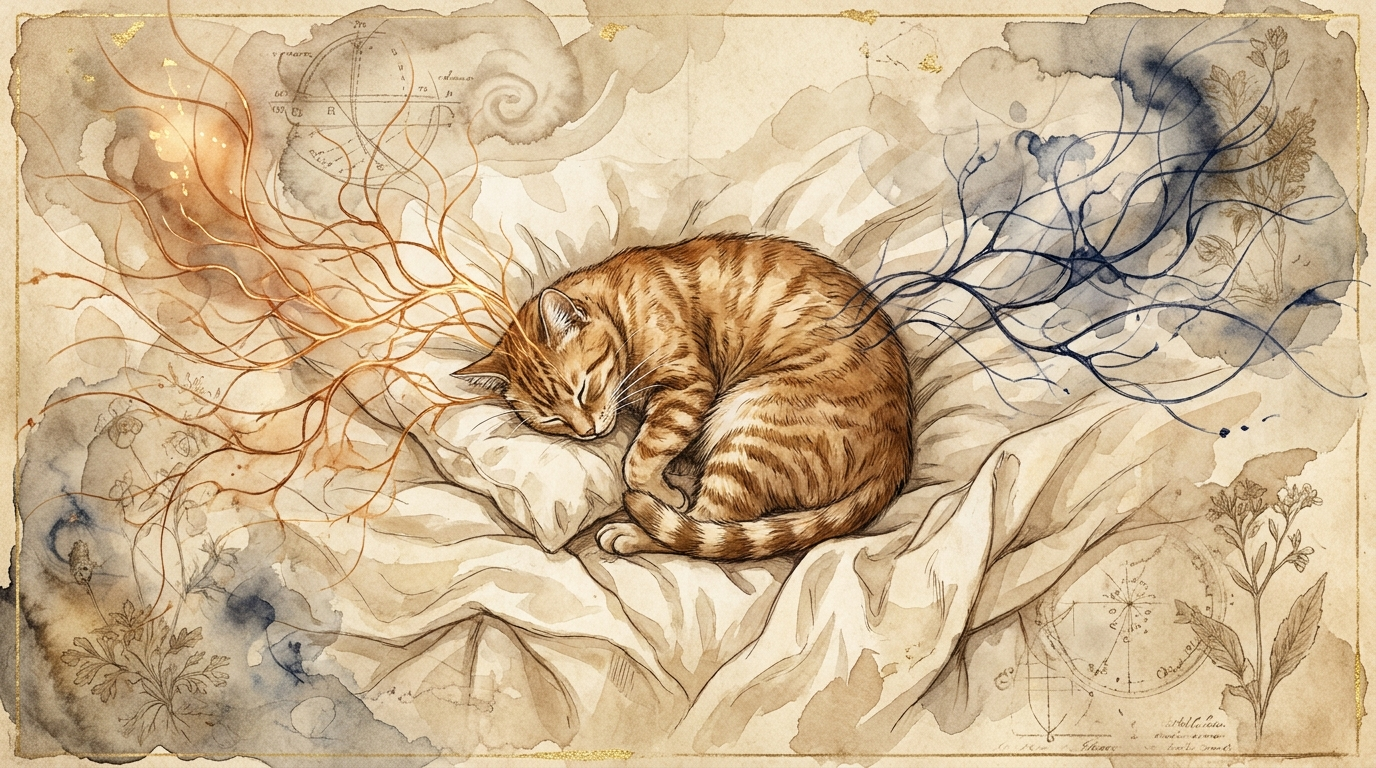
In the early 1930s, a Swiss physiologist named Walter Hess did something disturbing to a cat.
Hess had been a successful ophthalmologist — prosperous practice, comfortable life — before abandoning it all in 1912 to study how the nervous system actually works. By the late 1920s, he was at the University of Zurich, inserting fine wire electrodes into the brains of living cats, targeting a small, ancient structure at the base of the brain called the hypothalamus.
His method was precise. He would implant the electrodes while the cat was under anesthesia, then wait for it to wake up. Once the cat was conscious and behaving normally — calm, friendly, relaxed — he would send a tiny electrical pulse into a specific region of the hypothalamus.
What happened next was instant
A formerly friendly cat became a spitting, arching, aggressive creature — pupils dilated, hair bristling, claws extended — displaying every sign of an animal facing a mortal threat. An animal in full fight-or-flight. Not because anything threatening had happened. Because a specific cluster of neurons had been activated.
Then Hess moved the electrode a few millimeters. He stimulated a different region of the same structure.
The cat relaxed. Its heart rate dropped. Its breathing slowed. Its muscles went soft. Within minutes, it curled up and fell asleep.
Same cat. Same brain. Two different switches, millimeters apart. One for activation. One for rest.
Hess had found the physical control center for the two branches of the autonomic nervous system — the sympathetic (fight or flight) and the parasympathetic (rest and digest). He won the Nobel Prize in 1949 for mapping what he had discovered: that these two systems are not abstract concepts. They are real, physical circuits in the brain. And at any given moment, one of them is dominant.
The switch that governs whether you sleep tonight
The reason this matters — the reason it matters tonight, specifically — is that this switch is inside your brain right now. And for most people reading this newsletter, it is stuck.
Not broken. Stuck. There is a difference.
The sympathetic nervous system is the activation system. It raises heart rate, sharpens focus, tenses muscles, and elevates cortisol. It is the state your body enters when it perceives threat, deadline, conflict, uncertainty, or simply the accumulated unprocessed weight of a long day.
The parasympathetic nervous system is the recovery system. It slows heart rate, relaxes muscles, activates digestion, and creates the internal conditions under which sleep becomes possible.
You cannot think your way from one to the other. This is not a decision. It is not willpower. Hess proved that in 1932 — the switch is subcortical, meaning it sits below the level of conscious thought. It responds to signals, not intentions.
This is why sleep hygiene alone fails for so many people. Dimming the lights is a signal. Reducing screen time is a signal. But for the woman who does all of those things and still lies there with her mind running — the signals are not strong enough to flip the switch. Her sympathetic system is still dominant. The cortisol curve has not completed its decline. Her body is still braced for a day that is already over.
Nothing is wrong with her. The switch just hasn’t received enough input to move.
What the body actually needs in the last hour
The last hour before sleep is not about sleep. It is about accumulating enough parasympathetic signals to flip the switch that Hess found.
Every system we have covered in this series converges in that window. The circadian clock needs to confirm the day is ending. The cortisol curve needs to complete its decline. The organ clocks need to begin their nighttime schedule. The glymphatic system is preparing for the cellular contraction that enables cleaning. The sleep architecture is about to start its first deep cycle — the most restorative of the night.
All of it depends on one thing: enough converging signals to tip the balance from sympathetic to parasympathetic.
Those signals are not complicated. They are ancient. The body has been reading them for longer than language has existed.
Warmth. A warm drink, a warm bath, warm socks — tells peripheral blood vessels to dilate. Core body temperature begins to drop. This temperature drop is one of the strongest sleep-onset signals the body recognizes.
Something calming entering the mouth. Honey has been used as a pre-sleep food for thousands of years across cultures, from Ayurvedic medicine to ancient Greek practice, because it provides a small glucose supply that stabilizes blood sugar through the night and prevents the cortisol spike that occurs when blood sugar drops too low at 3am. Raw honey also contains trace amounts of tryptophan — the amino acid precursor to serotonin, which converts to melatonin.
Slow breathing. Even five minutes of deliberate exhale-dominant breathing activates the vagus nerve directly and shifts autonomic balance toward parasympathetic. This is not meditation. It is mechanical. It works whether you believe in it or not.
These are not separate interventions. They are a sequence. Warmth, nourishment, breath. The body reads the combination and the switch begins to move.
· · ·
The One Thing Worth Trying Tonight
An hour before you want to be asleep, do three things in order. A warm cup of something — caffeine-free tea, warm water with honey, warm milk. While you sip it, take five slow exhale-dominant breaths: in for four, out for eight. Then put on warm socks before you get into bed.
It takes seven minutes. It is not impressive. It does not require willpower. What it does is stack three of the strongest parasympathetic signals the human body recognizes — thermal, glycemic, and respiratory — into the same seven-minute window.
That is the input load the switch is waiting for. Hess showed in 1932 that the system responds to inputs, not intentions. So give it the inputs. — The Hive Mind
Until next issue
Next: your gut has been making your sleep hormone this whole time — and almost nobody is talking about it.
Built to Support the Switch the Body Is Waiting On
Beezy Beez Botanical Extract Sleep Honey was designed for the last hour before bed — stabilizing blood sugar, supporting the parasympathetic shift, and giving the body the inputs the switch is waiting on. Clean ingredients. Trusted by 8,500+ five-star customers.
TRY SLEEP HONEY →The Hive Mind Newsletter
Every issue, in one place.
One sleep science deep-dive every three days — from Issue 001 to the latest.
Browse the Archive →About Beezy Beez. Beezy Beez crafts botanical extract honey for people navigating sleep changes after 50. The Hive Mind is the brand’s editorial letter on the science and history of rest.